Blog

What Does A Gundog Trainer Do?

I love dogs, but I’m not a dog trainer. In fact, I have no formal training in any area of animal care or behaviour. As the Founder of The Ladies Working Dog Group, I spend a large percentage of time talking to both dog owners, and dog trainers. It’s a great job and it’s helped me learn so much about the important role gundog trainers play.

Let me teach you some things about what gundog trainers do,  and how you can use them to help you and your dog’s relationship flourish.


There is a lot to know and do as a pet parent, and there are many ways to help your dog be happy and healthy – from feeding them well to walking them often enough for their needs, to worming, and to knowing basic pet first aid, it’s a lot to take on.

And then there’s what we call “training”, which is teaching your dog how to behave appropriately in different situations so they’re happier as well as safer around others who might not appreciate their excitement!

On top of this general dog training, is the need for a gundog to understand far more when it comes to them carrying out a working role. So whether you want to learn more about this before you buy a gundog, or if you need some help with training a gundog breed, let’s discuss how a gundog trainer can help.

A gundog trainer helps you understand the basics of training a working dog

The basics of how to train a working dog can be tough, especially when the dog has forgotten he is meant to be listening to the owner and has decided to become self-employed instead!

A gundog trainer will get you started with training your new pup or help you with an older dog. Hiring someone who has experience in teaching a dog – like a trainer –  is going to help things go much smoother.

They also teach you how to interact with your pet gundog

Working dogs have a huge amount of energy physically, and a massive desire to be engaged mentally. Your trainer will teach you basic commands so that you can control these areas like sit, stay and come. They will also teach you how to focus your dog and how to meet their needs in a relationship-building way.

As your skills develop, your trainer will encourage you to take on more technical cues and they will help you to have lots of fun whilst you learn.

Your trainer will help you set up an appropriate schedule for your pup’s training that fits into your lifestyle.

Dog training requires you to be consistent. That can sometimes be tricky around family life, but your gundog trainer will help teach you how to do this. They help you understand how each dog differs and what kind can best suit your needs for that particular breed or type. Gundog trainers will teach you how to help a gundog breed happy live in a family home, while still being able to go out and do a working day on an estate.

Your trainer will work with both dogs and humans to make sure everyone is on the same page.

He or she can help you be more aware of your dog’s behaviour, as well as how they interact within a group setting so that you can train your dog to behave appropriately in a range of different settings and situations. They will teach you what you need to do to facilitate this as well.

Trainers are more than just teachers – they’re mentors too!

I am a trainer, not of dogs, but of people. I have been training people in mindset coaching for over ten years now. Here’s what you need to know about being any kind of trainer…

Trainers aren’t only focused on teaching skills; these professionals also provide practical advice from personal experiences with difficult topics such as anger management with your dog, through to ways to teach both you and your dog to switch off,  because we understand how hard training can be sometimes, especially when there isn’t enough space left inside ourselves anymore to go forward alone.

Your gundog trainer will teach you about how to be a better-behaved handler, and how not to be too hard on yourself. You’ll also learn about canine behaviour well as other skills such as grooming, nutrition, and health care during these sessions.

A gundog trainer is responsible for the training of a hunting dog.

Gundog Trainers work with you to teach your dog what behaviours are appropriate in different situations, often showing patience when it’s necessary, and understanding that each dog learns these skills slowly through repetition over time so they can remember them later on.

You may never intend on actually working your gundog, but it is important to still use the skills as it helps keep your dogs mentally stimulated and happy.

They teach the dogs how to hunt and retrieve games, and will teach you how to work your dog in the field if that is something you want to do.

Hunting dogs have been trained since ancient times to find the game and track it down with their noses until they could bring home an animal’s carcass.  The first step in moving on from a pet gundog used to training with dummies onto a working dog is to teach them what kind of game will be hunting or retrieving.

Working with a cold or warm game isn’t for everyone, and you can still train a remarkable gundog without it ever needing to touch a dead animal. However, if you want to go onto an estate a gundog trainer can help you to teach your dog to do this successfully.

They do so much more…

The LWDG Group and Featured Gundog Training Experts do so much to help all our group members. They check our pages daily, posting comments to help where they can, and producing our masterclasses, podcasts, and videos. They not only look after their own clients, but they help all of the community learn and grow. They do all the above and so much more! The best trainers not only care about their customers but also about the way gundogs are perceived by everyone.

We hope reading this post you’ve taken a few moments to think about what your dog training needs might be and how Gundog trainers can help. They will provide the knowledge and support that their many years of experience have given them and will also bring you the tools needed to train your dogs in order for you to succeed.

If any of this sounds like it could be helpful for you you can ask in our group for names of recommended trainers in your area. If there is anything else we can do to help you train your gundog please let us know!

Let us know if you have worked with a gundog trainer and how it helped you?

The Pinewood Training Vest

Happy Hotdogs recently sent 6 ladies from The Ladies Working Dog Group their Light Pinewood Training Vest for us to put them through their paces and see if they are worth the money and genuinely good for training. After being tested in the field, it turns out we think they’re pretty awesome. Sadly Happy Hotdogs are no longer around but the same vest can be found at Field and Fireside 

Review Written By Jemma Martin, from Whistle and Wag Dog Training


Earlier this year I was lucky enough to be asked to review the Pinewood light Pro training vest by Happy Hotdogs in conjunction with The Ladies Working Dog Group.

I have tried numerous training vests in the past for my gundog training and they are always too bulky or make me too hot or don’t have adequate space.

That is until I tried the Pinewood ‘New’ Light pro training vest!

Pockets galore in the Pinewood!

The first thing that needs to be noted is that this vest has no lack of pockets!

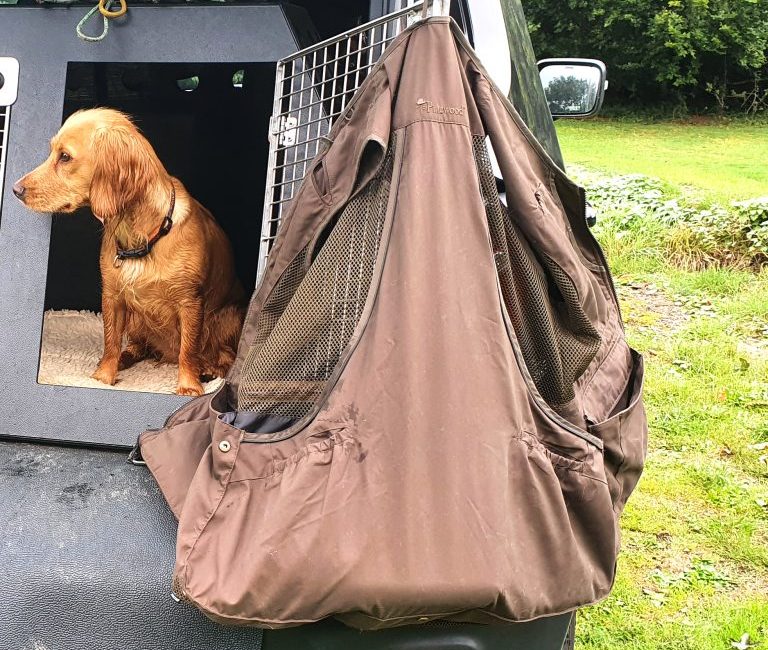
There is a spacious rear pocket that easily fits all the dummies I need for training and some tennis balls. I usually carry around 6 dummies but it would take more. The rear pocket has magnets that lightly close the pocket shut which helps to keep your dummies in place. This is a fabulous idea as I have had other similar size vests previously that dummies regularly fall out of which is a real pain.

As well as the large rear pocket, there are two dummy-sized elasticated pockets which would accommodate a further two dummies or water bottles for you and your dog.

Moving to the front there are two decent-sized outer pockets, great for treats or balls, or whatever you fancy really. The flaps of these also have magnets that keep them tucked in if required to allow easy access to the pocket.

There is a high zipped front pocket on the left chest which easily took my phone and kept it safe.

This is accompanied by two chest pockets that seal with a popper, which again would take a phone or keys or anything else small you may need to keep to hand.

The last thing on the front is the little elasticated whistle pocket, great to slide your whistle in when not in use so you do not have any ‘dipping’ accidents when clearing up after your dog. (I’ve been there, it’s not pleasant trust me)


You are probably thinking wow that’s a lot of pockets, but it doesn’t stop there! there are further two decent-sized zipped pockets inside. One has the rather special feature of a small opening that allows you to dispense poo bags from! Ingenious! It works fabulously with the rolls of poo bags you can purchase from most pet stores. The pocket the other side is a plain zipped pocket, but again great for anything you need to keep secure. Maybe a snack pocket with energy bars for you and your dog? Who knows, but whatever you want to take with you it will fit in this awesome vest!

Other features of the Pinewood

So apart from the more than ample pocket space what else can I say?

One feature I really like is it is made of hardwearing but super lightweight material, with a mesh section across the back and under the arms. This kept me cool even on warmer days where in my old vests I would have been seriously overheating.

MORE pockets! I forgot to mention 4 more pockets, yes 4! I wouldn’t suggest that these are pockets to keep things in but more for warming your hands. There are two high on your chest and two lower behind the front larger pockets. These are a great place to pop your hands when walking or training. I have a tendency to overuse my hands when training so they are great for me to pop my hands away as a conscious thing to get rid of them. Equally on a cooler Autumn day, it would be great to pop a couple of hand warmers in to warm your hands.

The front of the vest also has a small loop next to the left zipped chest pocket, this is great to attach a whistle on a cord to. This ensures you always have a whistle to hand with your vest and no panic that you have forgotten it.

Colours

Finally, this vest is available in 4 different colours.

Moss, Plum, Brown/Olive, Black

I opted for the brown/olive as wanted a colour I could wear when out working the dogs, but the other colours are great.

In Summary

I’m not sure I have anything negative to say about this vest! It’s lightweight, has tonnes of pockets, nifty little features like the poo bag dispenser and magnets and has a flattering shape.

They are currently £85 from Happy Hotdogs which offers excellent customer service with quick delivery. Go get yours today! Check out our other post for a fab discount offer, and Society Members can check out the Member Calendar ( July 1st) for an even bigger offer!

What do our other reviewers think:

Emma Stevens – Cunningshot Dog Training

The pinewood vest for me is fantastic, smart and useful. The sizing was spot on and I have used it for a multitude of reasons. Can’t wait to use it in the shooting season as well.

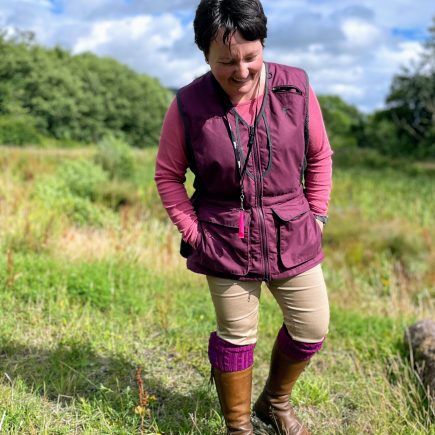
Emma Stevens in her Pinewood Vest

Charlotte Perrott- Pet Business Support


This vest has SOOO many pockets! It is absolutely perfect for everyone, however, I find it useful with my puppy. As we all know, puppies’ attention spans are a little (a lot!) shorter than adult dogs, so this vest allows me to have a variety of training equipment out with me to keep training interesting, instead of having to go back and forth to the car. I love the purple colour, it is a little more feminine than a normal vest as it fits to your shape. The vest is a great material, I seriously appreciated the little ventilation holes during the summer. The back pocket is huge- it can even fit a cavapoo!

The vest is very well put together, it allows a coat or similar underneath it during these winter months, there isn’t much that this vest can’t do.

Joanne Perrott- The Ladies Working Dog Group

I absolutely ADORE my Pinewood Vest- from the endless pocket to the secret poo bag compartment, it ticks all the boxes for training, and even just going for a walk with the dogs. When I first had the vest, I looked at it as though it was another piece of equipment I would rotate through, but it is a staple within my daily life.

I like the fact the pockets are big too, not just flimsy little ones that won’t fit a tennis ball. The phone compartment is very handy, and as Jemma mentioned- I love the little whistle pocket! I would describe it as an all-rounder, and even though it is a ‘light’ training vest, it is very useful for the winter season too.

Claire Denyer – Family Dog Services

I love the pinewood vest. It is practical, with many pockets and a spacious dummy holder, stylish, well-fitting, smart and comfortable. I have worn it to walk my dogs, train my dogs, and even when doing my KC working gundog certificate assessment with my youngest dog.

Samantha Thorneycroft- Taylor – Languedoc Gundogs

After eagerly awaiting the arrival of my Pinewood Training Vest, I was super excited to put it through its paces! It certainly did not disappoint with multiple front pockets, a spacious dummy compartment, and magnetic closures to decrease/increase the dummy compartment size, and it looks and feels great too.

Its sizing is spot on and it has a very smart appearance. The Pinewood Vest very quickly became my go-to equipment carrier especially as the weather improved and the mesh back allowed airflow whilst training in warmer weather.

I have used the vest for full days training multiple dogs/clients, and for more relaxed dog walks too – it’s been great for every use I’ve given it so far!

So there you have it, 6 different dog handlers, 6 very positive reviews for the training vest.

Sadly Happy Hotdogs are no longer around but the same vest can be found at Field and Fireside 


LWDG POD DOG – NEW PODCAST!

I LOVE listening to podcasts every chance I get: walking the dog, exercising, driving, showering…You get the idea!

So when a Group Expert, Emma Stevens, suggested we do a public podcast for everyone, it made me jump up and down with excitement! What could be better than offering a new way of learning that they could enjoy?

The LWDG already has a private Podcast for its members. We upload all of our live coaching sessions as both a video recording and a podcast for them to enjoy.

But we have never before created a dedicated place for anyone to listen to the amazing coaching of our Group and Featured Experts.

And so The LWDG POD DOG was born! A public podcast dedicated to all things working dog.

We wanted anyone to access, so it’s available here, on Apple Podcasts and on Spotify for you to listen to weekly.

Robert Alleyne

Rob Alleyne is an incredibly well-respected dog behavioural trainer, and last year he did a fantastic coaching call for our members. So good, we decided we would kick off LWDG POD DOG by releasing this incredible 57-minute coaching call!

This episode covers:

– How Rob became a dog trainer.
– Robs tv career training dogs.
– Dominance v Fear-based behaviours.
– Pup resentment in multi-dog homes
– Resource Guarding
– Socialising Dogs
– Aggression
– Fixing Recall
– Barking

More About Rob

Robert is a signatory to the Registration Council for Dog Training and Behaviour Practitioners (RCDTBP), and he has lectured on canine behaviour on many occasions for different groups and organisations, both nationally and internationally.

He is a Member of the Kennel Club and is a patron of the charity K9 Crusaders. He is a keen campaigner trying to make a difference for dogs in relation to their care and welfare, is firmly against breed-specific legislation, and has attended several of the London protests against it.

He has talked on many radio programmes on the subject of dogs. He’s also appeared on numerous television programmes talking about dogs and other animals. He was the behavioural trainer on the hugely successful BBC3 show Dog Borstal for all four series. He has also appeared on BBC News, This Morning, Good Morning Britain and London Tonight, covering a variety of dog-related subjects. He has written articles for most of the major national dog-related magazines, such as Our dogs, Dogs Today, and Your Dog.

Robert has acted as an expert witness in court cases, both as a canine behavioural/trainer and as an animal welfare officer for the London Borough of Lewisham.

After acquiring a puppy from Battersea Dogs & Cats Home in 1981, he began attending dog training classes with him and soon started working at competitive level obedience with both him and his next dog. He has run his own dog training classes since 1986. By 1994 he had won his way up to and including class ‘B’ before work commitments forced him to retire from competing. He has judged at limit, open, and championship level obedience competitions since 1986. He has been training people in instructing dog training classes since 1995.

Having spent some years studying the subject, Robert started working as a canine behavioural trainer in 1992, with most of his clients coming to him via veterinary referral or recommendations from previous clients. He has published a book on dog behaviour and training, The Trouble-Free Dog, published in 2000, and had very positive reviews in The Times, The Telegraph, The Daily Mail and Dog Training Weekly and has been reprinted twice since then. It was revised and reprinted in 2008. He is currently writing his second book. He has also produced several booklets and pamphlets for Lewisham Council on dogs, which are distributed free to the public.

In May 1990, he began working as an animal welfare officer for the London Borough of Lewisham and continued there until January 2007, when he held the position of Senior Animal Welfare Officer. Dealing with all types of animals, ranging from escaped reptiles to injured wildlife to nuisance complaints and of course – stray dogs, which was the service’s core function. This aspect of the job was obviously potentially very dangerous, so an ability to immediately assess a dog’s attitude was essential since stray or abandoned dogs could potentially turn aggressive. He left the service in 2006 to work full-time as a behavioural trainer.

The Welsh Springer Spaniel

It’s June and that means it’s time for our second blog post in our Vulnerable Breed Series! This month’s vulnerable breed is The Welsh Springer Spaniel. This blog has been kindly written for us by Jane Sutherland from the Welsh Springer Spaniel Club of South Wales, and the images used throughout have been kindly sent to us by Jane too.

To refresh your mind on what breeds are currently on the Native Vulnerable Breed list, please click here.

Background and Characteristics
The Welsh Springer is a very ancient breed that can trace its ancestry back to the 10th Century. It was widespread across the UK until the beginning of the last century and was often known as a Starter or Springing Spaniel. With the advent of the English Springer and then subsequently the Cocker Spaniel, the breed declined in popularity but held on in Wales and amongst enthusiasts of the breed, with its reputation as a tenacious game finder in hardcover and tough conditions.

The Welsh Springer is a medium-sized spaniel, smaller than the English Springer, symmetrical and compact, not leggy, strong and muscular. However, still quick and active and with a merry disposition. They are always a rich red and white in colour, with no exceptions, standing between 18 and 19 inches to the wither. The Welsh Springer Spaniel possesses superb scenting and game finding abilities as well as real versatility, happily adapting to any role in the field. From beating, picking up, duck flighting, sitting in a hide decoying pigeons to following a blood trail shooting deer, they are great working dogs. A very loyal and sociable spaniel, they love family life as well as  the working life so fit happily into your life and onto your sofa!

Welsh Springer Spaniel
Working A Welsh Springer

I have had and worked with Welsh Springers for over 25 years and am currently the Working and  Field Trial Secretary for the Welsh Springer Spaniel Club of South Wales. It would be wrong of me to suggest that they are easier or harder to train than any other spaniel. Like all breeds, it requires patience and consideration to get the best out of your Welsh. The Welsh Springer can be both stubborn and opinionated but once trained these characteristics to become a genuine asset, resulting in a shooting companion who is intelligent, determined and a remorseless hunter.

They are capable of going all day! We frequently arrive before the shooting day starts to push in the boundaries and arrive back at the Shoot Hut as everyone is leaving, having been asked to do a final sweep of the last drives to collect any missed birds. The breed is different in style from the other, more popular spaniel breeds. They are slightly steadier of pace which allows them to maintain the same energy and drive all day, they have outstanding noses, however, and very rarely miss birds, often finding blinked birds down rabbit holes or lost retrieves hung up in clematis or vines many feet above their heads.

Like everyone who works a vulnerable breed, we are inevitably the only representatives on a shoot, a double-edged sword because it makes your mistakes as noticeable as your successes! But it’s always a source of huge pride when the “is that a cocker then?” spaniel puts in a good day’s work and manages some eye-catching retrieves and flushes.

The Breed’s Versatility and The Welsh Springer Spaniel Clubs

I both work and compete my Welsh, attending Working Tests and Field Trials. We beat and pick up on local shoots and rough shoot over our team of Welsh. They also show and I  currently have the only one living Champion in the breed.

There are a dedicated group of people striving to maintain the dual purpose of the Welsh Springer, these happy adaptable dogs are able to segue effortlessly from Show Ring to Shooting Field to Family life and much more.

The breed is always represented at the Game Fair and I would encourage anyone who is interested in Welsh Springers to come along and meet us. There are four Breed Clubs nationally, and we are working hard to preserve this lovely gundog and to support research into the health of the breed.

To find out more about the Welsh Springer Spaniel, click the button below to view the Breed Profile on the Kennel Club’s website:

To read the previous blog of this series, click the button below:

The Sussex Spaniel

Let’s Talk Dachshund

You may be wondering why we have a blog on them, I mean, they’re just a handbag dog aren’t they? Actually, these little wonders are amazing working dogs. Dawn Seago, from K9 Lifestyles, did a Zoom call with us about her experience with The Dachsund- and has very kindly written this blog for us.

The History

The name Dachshund means “Badger Dog” in German translation, Dachs meaning Badger, Hund as a dog. Some say that the Dachshund originated from the Basset Hound during the French revolution, but Dachshunds were already in Germany at this time. Queen Victoria had a Dachshund called “Dash” bought for her by Prince Albert, they were thought to be in England before this though.

Dawn

Dawn Seago and Diesel

About The Breed

There are 6 varieties and three coat types recognised in the UK: mini smooth; mini long; mini wire; standard smooth; standard long; standard wire. No matter what the coat or the size, it is a Dachshund. Sometimes referred to as a “Teckel”, it is still a Dachshund, most commonly people call the wire-haired type Teckels.

They are clever, stubborn, lively, independent and very courageous, to the point of rashness. They are not a small little handbag dog, which is what they seem to be at present.  They will dig their way out of a garden if bored or restless, forget your nice flowers as they will have them destroyed if left to their own devices, I have lost a few flowers. They have immense power in forequarters and forelegs, when viewed from the front the thorax should be full and oval-shaped, this allows good capacity for the heart and lungs. The feet should be bigger on the front legs than the back legs to allow for digging. There is of course lots more to the Breed standard, so it’s advisable to research this.

Dawn’s Dachshunds

As A Working Dog

The Dachshund does not fare well being left alone all day, as boredom and destruction will happen. Like many dogs, they do not arrive in your home fully trained. They are highly intelligent and will manipulate humans quite easily, they are a Hound with a brain. Some breeders will say Wires are extroverts, Longs are laid back, Smooths are said to be the “one person dog”.  In training with your Dachshund- be consistent with it, they will be stubborn, and if they find a weakness? “Boom”, they own you. As they grow, find a job for them to do, all kinds of nose work are the best thing for a Dachshund. They were bred to hunt, harness that power and get them working. They love to track/trail, there are lots of scent work clubs to join. I have one who Tracks for wounded deer with BMH of GB, we train once a month. As a Mantrailing UK Instructor, they Mantrail too, (not looking for a man).  I even have a Dachshund who does Parkour and Hoopers. All of these activities are low impact sports so they are suitable for a Dachshund.  Talking of backs- yes, some do have issues with IVDD, just be watchful of things like too much jumping or stairs, keeping the Dachshund fit helps. There is lots of information on The Dachshund Breed Council Website.

Thinking Of Owning One?

Before buying a Dachshund, visit some conformation shows and talk to breeders. Find out the breed’s health status and ask questions. If you have made your mind up to welcome a Dachshund in your home, then talk to several different breeders- not just one. Choose your breeder wisely, and make friends long before you get your puppy, good breeders do not always have puppies on sale. I also show my Dachshunds to Championship level, and welcome people to chat to me about working their Dachshunds too.

Remember these little dogs love to work, they will surprise you with their tenacity to do a job.

To find out more about Dawn, you can visit her Facebook page by clicking the button below:

Fancy Something Different For Dinner?

We get it- thinking about what to have for dinner all the time is hard. We thought we would help you with a fantastic recipe from BRITISH GAME ASSURANCE– so, Fancy Something Different For Dinner?

Partridge Winter Salad With Salsa Verde

A warm salad, celebrating wonderful seasonal winter vegetables, accompanied with the addition of tangy satsuma.  Leeks make a great warm salad and using the stem of the leek in the salad, and the leaves in the salsa verde mean every part of the leek is used.

Salad Ingredients
  • 2 partridges
  • 1 leek stem
  • 30g (approx. 1/2 cup) watercress
  • 1 satsuma
  • Rapeseed oil
Salsa Verde Ingredients
  • 2 tbsp leek leaves, diced finely
  • Oil
  • 2 cloves garlic
  • 1 bunch of fresh basil leaves
  • 1 handful of fresh mint leaves
  • 1 tbsp capers
  • 1 tbsp gherkin, diced finely
  • 6 anchovy fillets
  • 1/2 tbsp Dijon mustard
  • 2 tbsp red wine vinegar
  • 6 tbsp extra virgin olive oil

Method

Salsa Verde

  • Finely dice the leek leaves (like the size of finely chopped chives), and gently fry over a medium heat in a little oil for 1 minute.
  • Crush the garlic cloves, and make it into a paste.
  • Finely chop the basil, mint, capers, gherkins and anchovy and combine in a bowl, and mix well.
  • Add the cooked leek leaves and stir through to combine.
  • Add the mustard and vinegar, then slowly add the oil until you achieve a nice consistency.  You may want to add more or less oil.
  • Taste, and add some black pepper, or a little bit of sea salt to adjust the balance of flavour, if you wish

Partridge

  • Preheat the oven to 180 C.
  • Heat a non-stick frying pan over medium-high heat and add a drizzle of oil. Season the partridges all over with salt and pepper, place in the heated pan, and cook gently over the heat for 3–4 minutes, until they start to become slightly golden in colour. Turn the partridges if necessary.
  • Transfer the partridges to a roasting tray, and roast in the oven for 8–10 minutes until the partridges are just cooked, but slightly pink inside.  (Whilst the partridges are roasting, cook the leeks per step 12 and assemble the salad)
  • Transfer the partridges to a warm plate and leave to rest for 5 minutes.  Cut the breasts from the partridges, and slice them into thin slices.

Salad

  • Slice the leek stem into thin circles.
  • Heat some oil in a frying pan and gently fry the leeks for 2 minutes over a medium heat.
  • Transfer to your serving plates
  • Pick the watercress leaves from their stems, and add the watercress to the leeks
  • Slice segments of satsuma, removing as much of the white pith as possible
  • Top the leek and watercress with slices of partridge breast, and sliced satsuma.  Drizzle the salsa verde over the salad, and serve.

And there you have it, tonight’s dinner plan is sorted! If you would like to view more fantastic recipes by our friends at the British Game Assurance, click the button below:

How To Work With A Cheeky Dog

claire denyer featured expert ladies working dog group

Guest Blog Post by LWDG Group Expert Claire Denyer

Do you find your gundog can be a bit “cheeky’ from time to time? That they know what they’re supposed to do but do the total opposite? One of our fantastic featured experts, Claire Denyer, has provided us with this amazing blog all about her training experiences, common mistakes and how to handle the cheeky gundog!


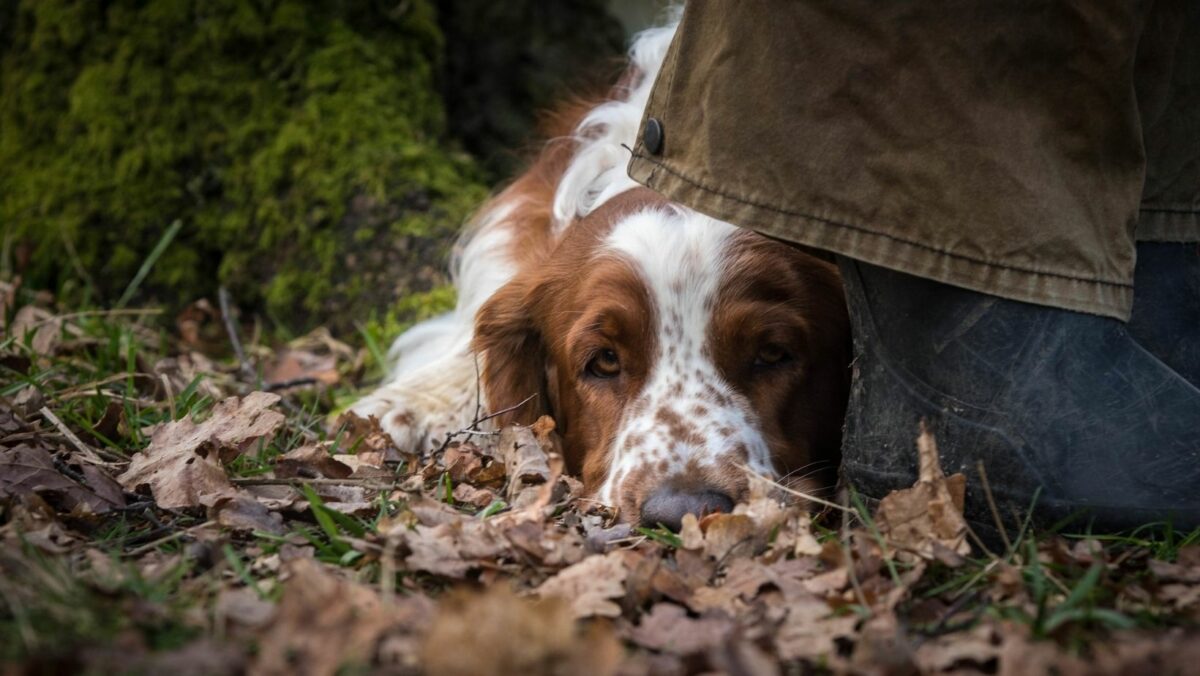
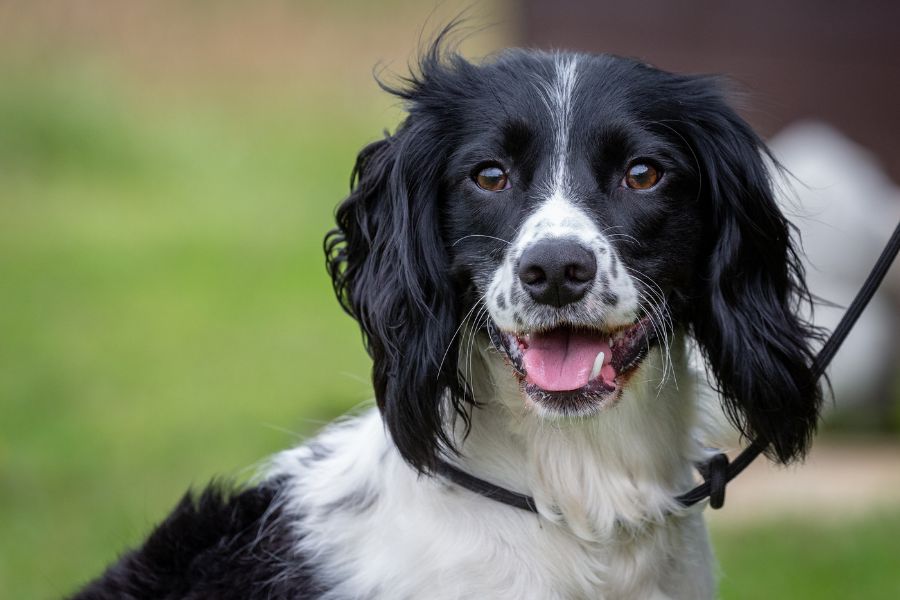
This is the face of a very beautiful and cheeky young gundog who knows she was very cheeky during training this morning. Training your dog won’t always go perfectly, it won’t always go as you thought it would. That’s normal and it is the reality.

What should I do when things go wrong?

I’m often asked what I do when things go wrong. The honest answer is that it totally depends on the dog I am working with, what has gone wrong, why it has gone wrong, the environment, and the situation.

I hope the following helps you think about what you should do when things go wrong…

Training

When we are training the dog, we are educating the dog. We may use luring, shaping, repetition, and consistency, to aid successful training. We encourage the dog to make good choices, and the gundog is rewarded for those choices. Behaviours which are rewarded are more likely to be repeated.

Duration, Distance and Distractions

Look at the duration, distance, and the distractions, and ask yourself if you have prepared your gundog enough, have you prepared them for each element, if not then go back a step in your training and build duration, distance, and distractions, in that order.

Proofing the training 

Ensure you proof the training in a variety of environments and under varying conditions.

Constructive Correction

However, if the dog understands what is required, but chooses not to comply, we use constructive and appropriate (not harsh or abusive) corrections to encourage the dog to make the right and rewarding choices in the future.  Correcting a dog does not mean being cruel. We do not advocate harsh handling. It’s not necessary or nice.

LWDG Group Expert,  Trainer  Claire Denyer

Common Mistakes

I thought I’d go through some of the more common mistakes we commonly see handlers make when correcting their dogs in gundog training:Many handlers use a ‘stern telling off voice’ but they raise their voice, some almost shouting, and the dog becomes numb to it, so often becomes ineffective, or in some cases, is always required because the gundog no longer listens to a normal speaking voice.

If done correctly, a verbal (non-shouty) verbal correction can work, however, you must also put the training in to teach the behaviours you want more of, and reward those behaviours.

Many trainers recommend ‘getting after your dog’ if they ignore the stop whistle or recall. Now, I will go out to my dog if she is ignoring me, but in most situations, I personally find running after dogs ineffective (unless you are trying to cut across their path to stop them from swapping dummies or similar). Some gundogs think you are joining in, some think you are playing chase and it becomes a game, some gundogs are very sensitive, and then it can create other issues. To be perfectly honest, I’m not sure I know many owners who could physically ‘get after their dog’ successfully anyway.

So unless it’s very effective for you and your gundog personally (or required in very specific situations) I would suggest you just go get your dog and walk them back on lead (do not give another command) to roughly where they ignored the stop whistle (I call this the walk of shame!) and sit them up, pip the stop whistle and resume where you left off. If they ignored the recall whistle then go get them, pop the lead on, and walk them back in silence, then do a successful mini recall to ensure you and your dog are on the same page.

If a gundog is repeatedly breaking a stay, don’t just correct the gundog, or get frustrated, look at the behaviour your dog is displaying in that situation. If your dog is creeping towards you it is very likely they lack confidence, or you have increased the difficulty of the exercise too quickly, so getting frustrated won’t help, and may even make the problem worse. A dog getting up and buggering off however is a different matter.

So, how did I handle Rose’s misdemeanours this morning?

Well, when she thought she knew best on a blind retrieve and ignored my line, going in the direction instead of where she had picked a retrieve previously, I called her back and reset her, giving her a chance to follow the line a second time. However, although she started well, she did again deviate from the line, so I called her back and walked her closer in the hope she would take the line and wind the retrieve. However, Rose clearly in a headstrong mood still didn’t follow the line. This time I walked her to heel towards the retrieve until I was sure she would wind it, I then turned and walked her to heel away from the retrieve, before turning and re-sending her, this time she took the line and was successful. The important lesson was that she didn’t find the retrieve when ignoring me. She found it through working with me.

We then resumed training but I was mindful to keep blinds short and successful.

Then two lovely retrieves later Rose tried to play keep-away with the retrieve, I mean, the last time she even considered such a cheeky move was such a long time ago I can’t remember. She was literally bouncing about playfully. Not a behaviour I expected nor want to encourage so I gave her my best-disgusted look, turned on my heel and started walking away. Rose followed me and gave me the retrieve immediately.

So, on that note, we decided to stop the session. No hard feelings. Never hold a grudge. Never get angry (even if inside you are fuming)

I never continue training if I feel frustrated or upset by something. It’s not worth it. We are only human. Better to stop and do something positive and leave your session with your dog still as your best mate.

Remember, gundogs make mistakes just like we do.

Further Info:

If you would like to purchase Claire’s book, The Life of Rose: Raising a Puppy the Family Dog Services Way, you can do so by clicking the link to our LWDG Amazon Store.

Find lots of gundog training books recommended by the LWDG community To view previous LWDG resources with Claire Denyer, please click here:

LWDG PODDOG is a podcast all about working with dogs. if you would like to listen then please click the button below:

Vulnerable Breeds Series: The Pointer

Welcome back to our Vulnerable Breeds Series! This month’s blog is on The Pointer. For those who are new to the series, this is all about raising awareness for vulnerable breeds here in the UK, starting with the native breeds. Following The Kennel Club’s Vulnerable Native Breed List, we are speaking to breed-specific clubs from across the UK to find out about the breed and what the club does to promote it. A huge thank you to The Pointer Club and their Honorary Field Trial Secretary, Carole Brown for giving us the context for this blog.

pointer pointing

About The Pointer

The supreme scenting machine, the Pointer is a wonderful example of a breed fit for its original function. The Pointer gallops on large expanses of land to detect the scent of the game and then freezes in a “point” in the direction of the sitting game.
The Pointer is an athlete, considered the thoroughbred of the gundogs. His hunting style is with head held high, galloping with style and pace, lashing his bee-sting tail. It is no wonder that the Pointer was much in demand by the gentry of the 18th and 19th centuries with large kennels of 200-300 dogs, as they were considered the most stylish of gundogs.


The Pointer is an active, intelligent dog who needs daily exercise and stimulation. They were bred to be hunting dogs who could work all day long so they must have at least an hour of exercise a day. When they are given the exercise and training they need, they are quiet and mannerly house dogs.

pointer dog

Kennel Club Breed Standard (Snippets)

General Appearance- Symmetrical and well built all over, general outline a series of graceful curves. A strong but lissom appearance.

Characteristics- Aristocratic. Alert with the appearance of strength, endurance and speed.

Temperament- Kind, even disposition.

Body- Well sprung ribs carried well back gradually falling away at strong muscular and slightly arched loins. Short coupled. Haunch bones are well spaced and prominent, not above the level of the back.

Colour- Usual colours are lemon and white, orange and white, liver and white, and black and white. Self-colours and tricolours are also correct.

 The club’s goal is to maintain and promote the breed as a ‘fit for function’, that is also suitable as a family member. The Pointer Club provides breed-specific input into the KC on our Breed Standard. The club is responsible to the KC as custodians of the Pointer breed standard and work with and advises the KC on all matters regarding breed health guidelines and manages a number of KC-related activities such as maintaining breeder code of conduct policies, running judge education seminars and managing judge accreditations.

The Pointer Club organises a number of events each year ranging from Shows (Championship & Open) and Field Trials. We also provide help and advice to members on training, owning, showing and working Pointers.

The Pointer Club has the declared objective of promoting the interests of the breed, uniting those interested in the breed and upholding the Standard of the Pointer

Working Pointers

The Club runs seven Field Trials each year in accordance with Kennel Club Rules & Regulations.

The aim of each trial is to run it as close as possible to a day’s shooting. The dogs are required to systemically quarter the ground with pace and style, showing natural hunting ability. They should point gamebirds and when asked, work out the point freely and drop to flush and shot.

In addition to the field trials, the club also holds up to three training days for Pointers and Setters per year. The aim of these days is to help educate & encourage newcomers to our sport. They are designed to help owners and their dogs to gain an insight into the background and basic training of a working Pointer or Setter and also understand more about the quarry and management of the ground that we work on. From attending these days, some participants are able to progress to a standard capable of competing in field trials.

To learn more about The Pointer Club, click the button below:


To view our last Vulnerable Breed blog on the Irish Water Spaniel, click the button below:

Irish Water Spaniel Blog

LWDG Collab With On The Peg

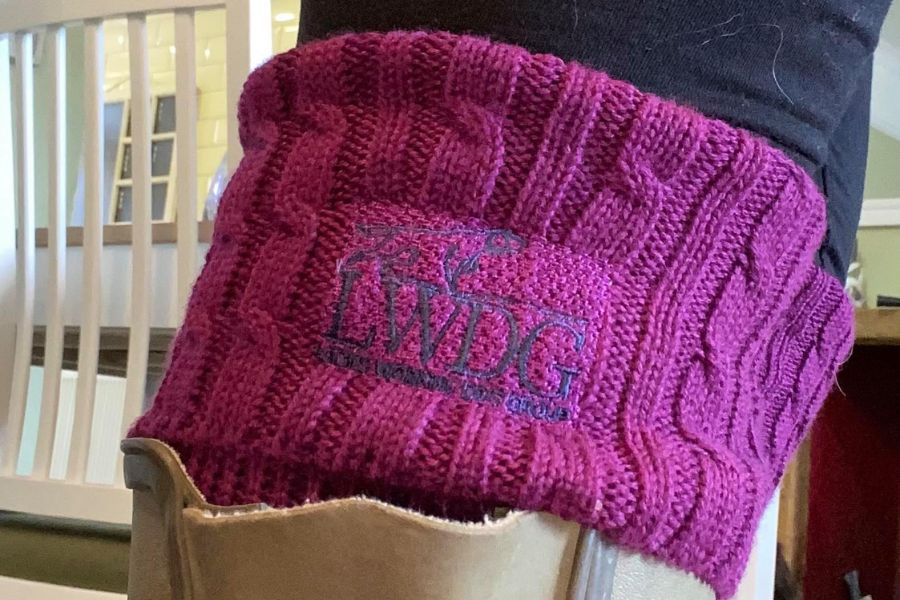
They’re finally here! LWDG have collaborated with On The Peg to bring you exclusive Lady Harris Shooting Socks and Wrist Warmers!


Both items are available in two colours- Bilberry (above) and Dark Olive (seen in the blog cover photo).

Merino wool ladies’ country socks. Lady Harris, understated and elegant, these country socks will add the finishing touches to your outfit. Beautifully knitted cable top sock in rich, vibrant shades – perfect for any occasion. As with all House of Cheviot’s shooting socks and country hosiery, Lady Harris is hand-finished to ensure premium quality.

These socks have the Ladies Working Dog Group (LWDG) logo on the folded top in contrasting gold.

There are also matching wrist warmers available.


We hope that you are as excited as us to finally have an exclusive sock for those shoot days, and cannot wait to see pictures of you all wearing them!

To get your matching pair, please click the button below:

How Do I Know When My Dog ’Knows’ Something?

One of our amazing Featured Experts, Leanne Smith, has put together this blog to help you understand more about your dog and how to help both you and your dog communicate more effectively.

Introduction

How do I know when my dog ‘knows’ something? This is the $1,000,000 question.

The answer to this question then dictates how we respond to our dogs both in a teaching or training sense and also in an emotional sense.

If we assume that our dog ‘knows’ a behaviour and our dog does not respond correctly, then we can become frustrated or disappointed that our dog has ‘failed’ or assume that our dog has deliberately chosen not to do what we have asked of them.

A wise person once said,“We expect too much from our dogs and not enough from ourselves”.

For what it’s worth, these are my thoughts on knowing when a dog ‘knows’ a behaviour.

I like to think of working with my gundog as a conversation.  I ask a question in the form of some sort of training exercise or set up and then let the dog answer the question with either getting things correct or making an error.  Errors are just information on the state of learning; where the dog is in their understanding of what is being asked.

I look at errors as holes in my dog’s learning which I need to find a way to ‘fill’ by doing more teaching in that area.

Leanne Smith

Principle 1 – Dog’s are very situation-specific with what they learn, they have to learn to generalise behaviours.

In practice, this means that the slightest change in the environment can interfere with a dog’s ability to understand what it is that you want from them.  As you train the same behaviour in 100’s different places with 100’s of successful repetitions, then a dog will begin to generalise a behaviour.

The more educated a dog is, the quicker it can generalise a behaviour as they learn the life skill of generalising.

I am more surprised when behaviour does work in a new situation than if it doesn’t.

Questions to ask ourselves when a dog makes an error: –

  • Have I trained this behaviour in this location under this specific set of conditions?

  • If the location is the same, are the weather conditions the same, dry still weather is low scent conditions, damp windy weather is high scent conditions?

  • Are the distractions the same, different people, different dogs, additional wildlife?

  • Is my dog cognitive right now or is he in the reaction part of his brain?

The answers to these questions will then affect how we need to proceed to help our dogs to give the correct answer to the question that we have asked, in the form of the exercise that we have given them to do.

We have to find a way to help them understand in that situation.

Picture of Erik and Ragnar practicing boundary work in a low distraction environment.

Principle 2 – Dogs do what historically has worked best for them.

This raises the question of motivation.  If my dog understands what is being asked of him, and still chooses to do something different then the value in doing what I asked is not sufficient.

An example of this is my GWP, I never managed to find something that was sufficiently motivating for her to choose to recall away from hunting game.  As a result, I managed her on a long line and harness in the areas that I knew would be an issue, and she free-ran only in areas where I knew she could make correct decisions about the recall.

I learned a valuable lesson from that gundog and now work really hard with all my pups to create the ultimate reinforcer that is more valuable to them than hunting game or anything else.

Principle 3 – 80% or above, the success rate in a given situation with ‘fluency’ is my criteria that my dog ‘knows’ something.

Dogs are not machines and they will make mistakes sometimes, as we all do.  However, if my dog has an 8/10 success rate, I would say that they have a good grasp of what is being asked.  In this article, I define fluency as the ability to quickly repeat the cue multiple times with no deterioration in the quality of response or increase in latency (time to respond from when the cue is given).

Principle 4 – Human error, did I ask the dog the right question or give him the right information?

I heard about some research that has been done looking at the number of errors a dog makes compared to the number of errors a handler makes in a training session.  It turns out that the dogs made four or five times fewer errors than the average handler (from what I can remember).

This is a very important question to keep asking ourselves.  Videoing our training sessions can be very enlightening.  Quite often what we think we are doing; is not what we are actually doing!  We can create confusion in our dog, and not understand why.  Seeing what is we are actually doing, can clear up many training issues, by showing us what we need to change.  This can either be in the way we handle or how we communicate with our dog.

How does this help?

Since I have taken this approach to errors that occur in a teaching or training session, it has helped me to be able to see why my dog wasn’t able to give me the correct answer, which, in turn, has helped to reduce my frustration during working with my dog.

The first processes that I go through when faced with an error are checking in my mind, does my dog understand what I am asking, and is he motivated to do the behaviour.

Once I have recognised the main source of the error, either understanding or motivation, or sometimes both, then I can look at ways to fix it.

When the error is caused by a lack of understanding I look at how I can break the problem down into smaller chunks.  See the example below.

An example – 

My dog is steady at home with one other familiar dog but can’t manage to be steady in a group situation in a different environment.

I would split that down in to stages, only progressing when I get 8/10 success rate

  1. Work on steadiness at home with one unfamiliar dogs
  2. Work on steadiness at home with two unfamiliar dogs
  3. Work on steadiness at home with three unfamiliar dogs
  4. Work on steadiness at home with four unfamiliar dogs
  5. Go to the different environment and work on cue discrimination, stay, retrieve, plus other cues as an only dog.
  6. Work on steadiness in the new environment with one familiar dog
  7. Work on steadiness in the new environment with one unfamiliar dog
  8. Work on steadiness in the new environment with two unfamiliar dogs
  9. Work on steadiness in the new environment with three unfamiliar dogs
  10. Work on steadiness in the new environment with four unfamiliar dogs

I could also split these sections down further if my dog was still making errors.

When the error is caused by a lack of motivation then I will use management to prevent my dog from self-reinforcing in the short term and go back to basics and build better motivators for that dog.  When looking at creating better motivators I start in a very low challenge environment and then work back up to the problem environment.

If my dog looks ’guilty’, does this mean that he understands that he did the wrong thing?

Probably not, is the short answer to that question.

There have been studies done observing dogs’ reactions to situations looking at exactly this question.

A dog was left in a room with a piece of food and told to leave it, the owner then left the room for a short period of time.  They were told to either act happy or cross when they returned regardless of whether the dog had eaten the food or not.

What they found was the dog reacted positively if the owner came back in happy and in a ‘guilty’ way, when the owner came back in the acting cross, regardless of whether or not they had eaten the food.

The dogs were responding to the owner’s body language rather than the situation.

When dogs sense conflict building, they will generally try to appease and diffuse the situation.  Unfortunately for dogs, this behaviour has been labelled as ‘acting guilty’.  The more that the dog tries to appease the owner, the crosser the owner becomes, as they think that the dog is acknowledging wrong doing.  In actual fact, the dog is trying to say please stop being cross.

Dogs are very good at picking up when we are less than impressed.  For some sensitive individuals, indications as slight as a bit of a tut under your breath or a sigh can be enough for them to realise that something is wrong.  Not necessarily what or why something is wrong, but that there is something wrong.

If we look cross when the dog returns to us the chances are that he will sense something is wrong and display some sort of appeasement or displacement behaviour.  What that behaviour is, depends upon the dog’s personality and the level of ‘agro’ being displayed by the handler.

These behaviours can be as extreme as belly crawling, urinating, or rolling on his back.  It could be much more subtle, tail down lower than normal, hindquarters dropped slightly, turning his head sideways onto you, ‘smiling’- where he pulls his lips back in a submissive grin.  It could also be ‘crazy behaviours, having a fit of the zoomies, or playing keep away.

Videoing also helps us to see the really subtle signs of disapproval that we give out and how this affects our dog’s behaviour.

To read more about Leanne’s work or to visit Leanne’s website, please click the button below:

The Irish Water Spaniel

It’s July’s edition of our Vulnerable Breeds series! This month, we are looking at the Irish Water Spaniel.

The Kennel Club’s Native Vulnerable Breed list has many native breeds that are under threat, so the LWDG have asked breed clubs to tell us about their breed to help promote them.

We asked the Irish Water Spaniel Association to help us educate about the breed. A huge thank you to them for contributing to this blog!

Breed Profile

The IWS (Irish Water Spaniel) is a highly intelligent dog and may not be for the ‘fainthearted’.  You will need a lot of patience for this slow, maturing breed. However, this will be rewarded with a loyal companion.

It is best to start them at a few weeks old to recognise the whistle by using it to call them in at feeding times (this imitates the recall when working later on). As they grow, ‘little and often’ obtains the best results! They will naturally carry their toys, etc around. To build on this, we introduce some basic obedience to gain control, which you will realise is of utmost importance as you progress. Training can start in your garden or enclosed area.

Socialisation is paramount once they are able to go to public areas because as a breed they can be ‘aloof ‘ and wary of strangers.

What Does The Kennel Club Say?

The Irish breed club was founded in 1890 although liver-coloured water dogs with curly coats, top knots and rat tails had been known for centuries before that date. One of the most influential dogs in Ireland, Boatswain, was born in 1834 and his bloodline can be found throughout the world. His breeder Mr Justin McCarthy was a pillar of the breed.

Although the breed is classified as a ‘spaniel’ he works as a retriever, particularly in retrieving from water. In the UK he runs in retriever trials.

Theories on the ancestry of the breed include the French Barbet, the English Water Spaniel (now extinct) and the Poodle, which was originally used as water retrieving breed.

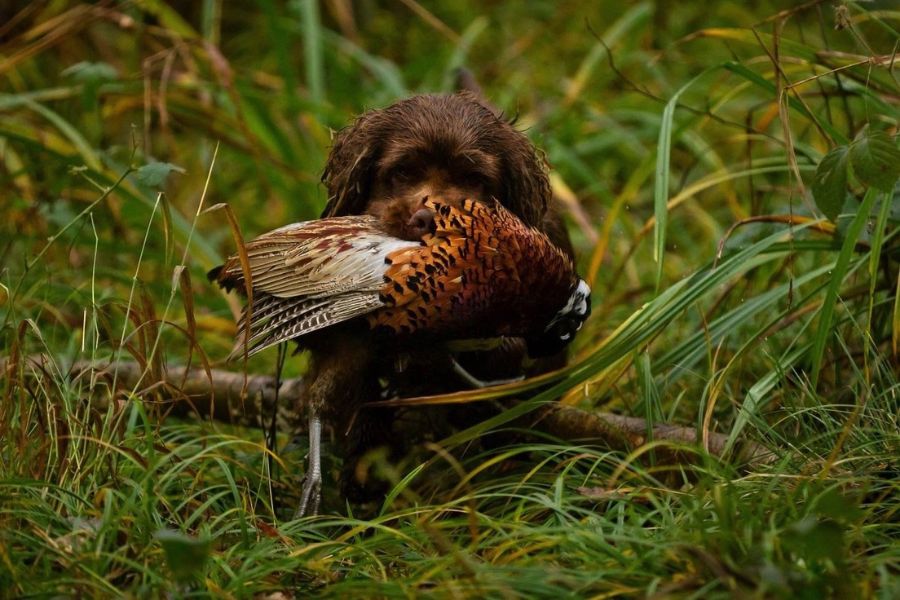
IWS with a pheasant
Working The Breed

The IWS are a compact powerful dogs which was an old Irish breed for working the peat bog areas (sometimes fondly referred to as the ‘Bog Dog’). They have large webbed feet to obtain stability on soft ground, also making them great in the water. As a Spaniel, some do naturally quarter however for competition purposes the KC here in the UK classify them as a Retrieve. This is also the same as the Irish KC.

A Note From The Irish Water Spaniel Association

To progress with your IWS, try to locate a trainer with knowledge of the breed. There are 2 KC registered Breed Clubs for IWS. The IWSA holds various events throughout the year catering for all aspects of the breed; including Training Days and access to experienced owners who work their dogs. For help and advice, more details can be found on their website. Alternatively, you can find them on Facebook at UK Irish Water Spaniel Association.

The Sporting Irish Water Spaniel Club (SIWSC) also has a website and a Facebook page for details of their activities. As you gain experience, you could decide to go on some shoots picking up or beating, some may decide to compete in Working Tests or Field Trials.

In conclusion, the IWSA would like to wish you every success in anything you try to achieve with your IWS companion.

Exciting News! We Are British Game Assurance Brand Partners!

We are so excited to announce that this month we officially became Brand Partners of the British Game Alliance!
Who Are The British Game Alliance?

The British Game Alliance was set up to promote, develop and assure the consumption of game meat by creating a thriving game meat market, underpinned by an independent assurance from egg to plate.

All BGA’s Brand Partners are companies who support the mission of the BGA and want to support their vision of an independently-assured game shooting sector and a thriving game meat market.

If you would like to find out more about The British Game Alliance, please click the button to visit their site below:

What Are We Looking For In A Dog Training Vest?

Update : Our trainer review can be found here
With summer in full swing, many of us are looking for a new dog training vest. In our Facebook communities, ladies post questions like:
  • Can anyone recommend a hunting vest for the larger lady?
  • Best company to buy a training vest from??? And which one?! 😳. I have a feeling the waistcoat type might get too warm.
  • I think the time has come to treat myself to a dummy vest any suggestions please appreciated
  • my current cheap “falconry” dummy vest has given up and I have the cash aside for a new proper training vest. What do we all recommend? It will be for all-year wear and I normally wear mine when working them too, so good for game as well as dummies (don’t put the game in the vest but may get splattered as I use my over-shoulder game carrier)

So when our lovely member Heidi told us all about a new lightweight vest she had seen at a dog show, we were all ears!

Heidi told us that she had raved to Mark, owner of Happy Hotdogs  about our group and he wanted to chat to us about reviewing the New/Upgraded – ‘Light’ Pinewood Professional Dog Sports/Dog Training Gilet For Ladies

We chatted to Mark and agreed to review the Pinewood Training Vest with some of our incredible Featured Experts and team.

As you know, we take reviews incredibly seriously in the LWDG.  And we want to put this vest through its paces. So our reviewing team includes:

How are we reviewing the vest?

Our review team are going to use the vests in their day-to-day dog training lives. Then they will post on Instagram and Facebook about the vest, so you can all get genuine feedback on how the vest performs. Integrity is everything to us, so we will be honest throughout.

At the end of the review period, we will collect all their feedback and put it together in one blog post for you to read. You can find their individual posts using the hashtag #lwdghappy

Sadly Happy Hotdogs are no longer around but the same vest can be found at Field and Fireside 

Leave

Getting Prepared for A Litter

Are you getting ready for your first litter? Or perhaps you have had litters before but you’re not 100% on the best equipment for the arrival, whelping or rearing?

Welcoming new life into the world can be very rewarding, but it can also be quite difficult. This blog post includes some of our member’s comments on the things you may need to welcome your litter into the world, and they also cover what to expect. More of our member’s expertise can be found in the Ladies Working Dog Group Free Facebook Community. 

setter dog with puppies drinking milk

CLAIRE

A whelping box, rubber matting, stock up on newspaper, a heat lamp and a digital thermometer!  I kept an entire litter once, so keep what (puppies from the litter) you want!

HATTY

Puppystim on Amazon. Literally a puppy life-saver. I will NEVER be without it.

GRACE

Have a plan for when they’re 4 weeks + – ours stayed in their whelping box as it was massive, but we put them onto shavings in it whilst trying to house train them as much as we could, we found it far easier than newspaper! Lots of towels, puppy milk & syringe just incase. Take temp and keep an eye.. mine didn’t eat breakfast the morning of both her litters. She was a week early both times also, but I had no idea the first time, called her to the front door and she come for late checks at the stables, it was only once I’d had a shower and went to bed I noticed a puppy squirming around 😳safe to say I put them both into the whelping box and had to sit with her for the duration of labour.

NICOLA

When it comes to worming pups buy paste not liquid. More liquid ends up out of the puppy than in it 🤣 Also don’t be tempted to let people come and see to buy until you are 100% which one you are keeping.

LUCY

Budget for a caesarean (in our hospital that can be £1-2k!). You’ll need to worm daily from day 40 of pregnancy to 2 days post-whelping. Familiarise yourself with complications to look for and the normal progression of birth. Sort your vet out ASAP for docking (if necessary for your breed) as most vets don’t do it anymore. Read “Book of the Bitch”.

SELINA

Read up on pre eclampsia/ eclampsia before she’s pregnant and again before she’s due. Know the signs. Also learn about mastitis treatment, quick treatment for these sort of issues can prevent the need for intervention.

NAOMI

Vet bed for mum, I litter trained my pups which made things so much easier. Look at wheatgerm and raspberry leaf extract supplements (dorwest herbs). There’s lot of great resources out there to read on, puppy culture and book of the bitch for example. Also if you can find a local experienced breeder who’s happy to be on call during whelping, as there may be things you’ll worry about that’s normal and save a unnecessary trip to vets. If things do go wrong, get a few bit of dollar stashed in the bank. It can get very expensive very quickly. Most importantly find time to sleep and relax, it’s bloody hard work but so worth it.

KATHY

I prefer a special heated mat to a lamp then puppies can choose to get on or off it..especially when the bitch starts to leave them for exercise etc. Also try and have a friend who has delivered puppies before with you during whelping…(this is) always helpful if one needs a bit of extra care.I stay with the bitch all the time once she’s started. Good luck and enjoy.

LORRAINE

Best to have plenty in the bank in case of complications, c section etc as insurance doesn’t usually cover that. Plenty of old clean towels, sheets newspapers as it gets Very messy lol. If you know any experienced breeders as friends, it’s good to have on speed dial. I also take my bitches temperature from a day or two before she’s due as it changes before she goes into labour.

golden retriever puppies

If you are interested in purchasing the “Book of The Bitch” as mentioned in the comments above, you can get yours by pressing the link below:

Maybe you’re not looking to breed and would rather help with purchasing a puppy. Click the button below to go to our blog on top tips for choosing a working puppy:

Isolation and Training

Isolation and Training

Written by Charlotte Perrott

As the lockdown continues nationwide, a lot of us are feeling a sense of loss. That loss may be routine, a job, or maybe even a loved one. I know I am feeling a sense of loss too. This blog is dedicated to those, like me, whose lives have changed due to the pandemic. Also, as those who are also struggling with their mental health at this time. Today, I’m looking at self-care tips, training tips and important information for those who are feeling the struggle.

Self Care

Self-care is becoming increasingly popular. It’s not necessarily running yourself a bath and chucking a bath bomb in,  but it is little things that you can do on a daily basis to help you feel better mentally. The whole point is that it is baby steps- not drastic measures- in order to have a small win each day mentally. It’s important to remember that no one among us has been through this pandemic before. So, if today you couldn’t even get out of bed, it’s important to be kind to yourself and allow yourself to have an “off day”.

Tips
  1. Move! Not only will your dog(s) thank you for this, but it’s just as important mentally as it is physically. Do at least 30 minutes of exercise a day. Now, I don’t mean that you need to do 30 minutes of high-intensity, “I’m gonna collapse!” workout routines; but even if you just managed 3 x 10-minute strolls a day, it will be beneficial for both mind and body.
  2. Take in your surroundings- when I first looked at what self-care was best and came across this, I thought- “what is the point of staring out of my window for 5 minutes?”. However, arguably it does help. Just sitting and listening to the world around you, whether that be in the countryside or in the city, can help you bring a little bit of mindfulness into your day.
  3. Sitting and scrolling- I am the first to say that I am addicted to Instagram. It helps to escape reality and live in a world full of influencers, celebrities and companies. However, sometimes Instagram can seem absolutely perfect, with perfect bodies, houses, jobs, dogs and so much more. Try and limit the amount of time you spend scrolling. Don’t eat the salad if you don’t like it. There’s enough to stress about at the moment without adding extra pressure on yourself to look a certain way. Eat well, move more and remember that not everything is as it seems on social media.
  4. Plan your (and your dog’s) menu and training for the week- I love organisation, and if I don’t plan my food for the week, I end up impulse buying which isn’t good for me mentally. Having a plan for both training and eating means you free up time and eliminate the purchases or rush decisions you make; this means that you probably will make better choices for both you and your dog(s).
Training Tips

 I spoke to our featured experts about their top tips for training your dog within isolation/lockdown, here is what they advise:

  1. Stripping training right back to the basics and adding enrichment. There is no point adding extra stress with training during an already stressful time, remember to be patient as stress travels down the lead.
  2. Make an individual plan for each dog and stick to it. Each dog is a different age and has a different personality so remember to tailor it to suit each dog and make sure the plan is stuck to. Not everyone will have access to training facilities and game, so it would be helpful to use this time to train obedience and technical retrieves for the more advanced dogs.
  3. Use the LWDG Magic Month planner for clear goals to be set during training, and use it to write each dog’s progress, strengths and weaknesses.
  4. If you have bought a puppy in lockdown, the chances are when you go back to work, that puppy is going to suffer from separation anxiety. Practice leaving your puppy alone for short breaks and building the time up. The best time to practice this is when the puppy is sleeping., this is usually a good time to leave them alone.

You can purchase your very own Magic Month Planner by clicking the button below:
Useful Contacts

We know that we have an amazing community where ladies can reach out and help each other, but we also know how important it is to seek professional help if you need it. Below are the telephone numbers for various mental health charities that can support you during this difficult time:

Samaritans- Confidential support for people experiencing feelings of distress or despair. Phone: 116 123 (free 24-hour helpline)

Refuge- Advice on dealing with domestic violence. Phone: 0808 2000 247 (24-hour helpline)

Mind- Promotes the views and needs of people with mental health problems. Phone: 0300 123 3393 (Monday to Friday, 9 am to 6 pm)

You can find more helplines for various mental health concerns by clicking the button below:

CLICK HERE

Vulnerable Breed Blog: Sussex Spaniel

This blog is the first of the series where we speak to a club about their vulnerable breed. Using THE KENNEL CLUB’S NATIVE VULNERABLE BREED LIST, we reached out to different clubs about their breed. We asked how they are used for working and how the breed has unfortunately ended up on the list, alongside their characteristics.  This time, we are looking at the Sussex Spaniel. We spoke to the Sussex Spaniel Association who have very kindly produced this blog and given us the images used throughout.

The Sussex Spaniel

Background

The Sussex Spaniel is named after the place of its origin. They have proven to be a very capable and reliable companion out in the field. This has been since its establishment as a working gundog, sometime in the middle of the 18th century.

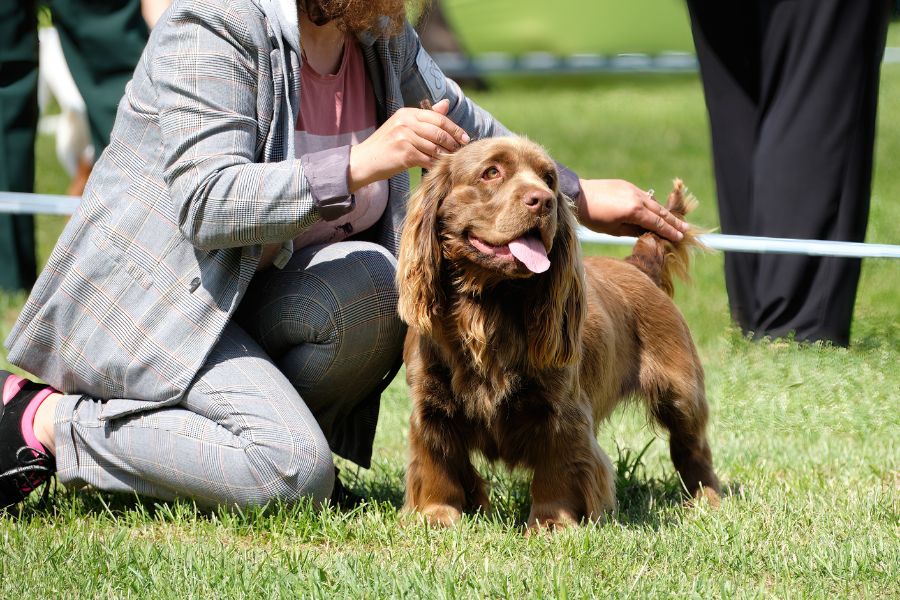
The Sussex Spaniel was developed specifically to hunt gamebirds close to the gun in short, dense cover. This led to them being shorter and longer than other spaniels with a rectangular profile and a strong muscular physique. This makes them ideal for not only dense cover but the heavy ground. They are a heavy set breed, weighing between 20-25kgs. They should stand between 15 -16 inches tall. The colour is unique, liver with golden tips. They have a slower, but steady pace and can go all day on the beating line using their exceptional nose. They tend to prefer to go under or through rather than over obstacles.

Characteristics of the Sussex Spaniel

The KC Breed Standard states under Characteristics:  “Natural working ability, gives tongue at work in thick cover”-  this is unique. The origins of the dog-giving tongue are unclear. However, it was most likely that it was encouraged because of the aid it gave to those out shooting. In dense cover, if the dog is making a sound it is easier for the guns to mark where it is, this alerts the gun to a potential flush and from where it will come, giving the shooter every chance of success. We have personally found when attending small shoots that the guns have appreciated the dog making noise before a bird is flushed. However, on the larger shoots, it is not so much required.

Working A Sussex Spaniel

A dedicated group of Sussex owners regularly attend shoots to beat with their Sussex and others rough shoot over their dogs throughout the shooting season. They have a great nose and very rarely miss a bird. Between drives, they are calm and happy to sit quietly and can often be seen having a quick nap – a great difference compared to other spaniels! It gives great pride at the end of the day when the guns become interested in the breed as they have seen them work well.

Training A Sussex Spaniel

The Sussex is a natural hunter. Furthermore, with good and sympathetic training, they can learn to retrieve game. Like all training, it needs to be done at an early age and above all made to be fun. Sussex can have a stubborn streak; if they decide enough is enough you have to be prepared to listen and come back at another time.

About the Sussex Spaniel Association

The Sussex Spaniel Association is committed to maintaining the breed as a working gundog and continues to organize a variety of working and training events throughout the year. This includes an annual Minor Breeds Field Trial one of only two breed clubs that have maintained this commitment.

The Sussex Spaniel Association take pride in the fact that the Sussex remains a true dual-purpose dog and is quite happy in the show ring on one day and equally happy the following day hunting in the field. Currently, there are two full Champions in the breed following their success at Minor Breed Field Trials.

Sussex Spaniel Association Website 

Looking For A New Lead?

Product Review by Joanne Perrott, Founder of the Ladies Working Dog Group

A lead is the one piece of equipment I cannot do without. Whether it’s for teaching a puppy heel, or for walking an older dog in a farmer’s fields, leads are there to ensure our dog’s safety.

And its also one of the things where you get to add your own personal style and flair if you wish. Whether you just want practical, to add a little colour, or to add some elegance, leads are one of the places where you get loads of choices and colours.

I was gifted 2 sets of leads and collars from Tetherleads. As you know integrity in what we share is really important, so in true LWDG style, I have put them through their paces.

For me, the design and feel of the lead are so important: something that is too short, too long, too hard to hold,  or too fiddly are all factors that contribute to a walk or training session feeling a little difficult.

Ella wearing her Tetherlead slip collar.

What Are Tetherleads?

Tetherleads make leads that are beautifully handcrafted in England using the finest Italian leather, solid brass fittings and hand-finished waxed stitching.

The unique design of the lead allows you to adjust the length of the lead and gives you the ability to secure your dog to almost anything.

To use you un-clip the bridle hook at the ‘handle’ end of the lead and wrap it around your chosen anchor point and attach it to the brass eyelets or rings that run the length of the lead at your desired length.

I chose the Oxford set (slip collar and lead) in black to match Buddy, and the Woodstock set in Tan to match Ella.

Their leads are a standard length and come with a 12-month warranty.


What Did I Think?

Overall, I totally loved them, and the dogs did too. The ability to tether the dogs to things made life so much easier, especially as my two dogs are litter mates and at the same stage in their training.

For example, In a training session with both Buddy and Ella, I used the leads to tether one to a nearby tree whilst I trained them individually. It was so helpful to have a fast way to clip and unclip into anything in my surroundings – the leads basically acted as a helper wherever I needed them. I also used them on a gate, and a large tree stump and the little links made it so much easier to attach the dog to whatever I needed, including myself to walk hands-free!

In my opinion, both leads are great,  however, the Oxford lead was my favourite. Not only did the lead look really smart, but the quantity of little belt-like holes made adjusting the lead a lot easier. The Woodstock lead has much bigger loops, which I didn’t find as easy to grip or adjust for heel work and training where I needed to keep Ella closer.

Even my husband liked the way the leads could clip anywhere and happily attached Grace ( our older dog) to his rucksack whilst out walking.

I used these leads daily and really appreciated the fact that the leads coped brilliantly in wet weather, water ran straight off and I wasn’t left holding a soaking wet rope.  I grew up riding horses and for me, a leather lead just feels so great to hold, and like a wet rein, it doesn’t slide around.

The quality of the lead itself is immaculate. The stitching is perfect and the clips were strong and durable. It is quick and easy to clean them by wiping them down with a damp wet cloth. My rope leads need regular machine washes with muddy spaniels so the ease of cleaning these is appreciated.

Tetherlead Collars

The leather collars were very smart, the thickness of the leather is beautiful and, not much beats the look of a handcrafted leather collar!

As there is now legislation around dogs wearing a collar with a tag in public places, I  am so glad that these collars felt lightweight for the dogs and were very easy to put on and off so that we could comply with the law. The colours matched the springers beautifully too. I liked the fact that when we were just having a family walk they could wear their collars and I knew they were safe and secure.

The slip collars were great for training, and I liked the fact they were thinner than a normal slip lead as it allowed them to self-adjust easily to keep the dog safe. The slip lead also doubles as a great heeling lead or a steadiness tag.

Both the slip lead and collars work with the leads, making them perfect for a shoot day or a training session.


Where Can I Get My Paws On One?!

We know lots of you have already taken advantage of the 15% offer for Society Members and already purchased a Tetherlead. Comment below what you think about them too.

Click the button below to visit our friends at Tetherleads. If you are a society member, there is a Society Exclusive offer.

Once you have your new beautiful lead and collar, please tag us and Tetherleads in your social media photos so we can see how well you get on with them!

Love Jo xx

Top Tips For Training A Reliable Recall

The Importance Of Reliable Recall.

Reliable Recall is one of the cues your dog has to master. There will be so many times you need your dog to return to you quickly, without hesitation. Recall is essential for all dogs, but even more so for a working dog. Featured Expert Claire Denyer explains the importance of a reliable recall and some steps you can take to improve your dog’s return to you.

The Problems We Face With Poor Recall

It’s important to remember that it is rarely the dog’s fault when things go wrong. It’s pretty common for owners to get over-excited and rush through training a young dog, especially when things appear to be going well. However, if training is rushed or the basics are skipped you may find things start to go wrong later on.

Rose and Dude (two of our current Labradors) have always had a pretty reliable recall, even through adolescence. However, I do remember that Indy’s (the third of our current Labradors) recall seemed to disappear overnight at seven months of age. I remember all too clearly calling John as he had been out with Indy for a rather long time and when he answered the phone he stated: “I’m coming home without the dog” in a rather angry voice. It turned out he had been trying to get her back for 20 minutes and while she hadn’t run away, she was having a wail of a time bouncing around just out of reach. She went back on a long line for a couple of months until we felt confident her recall was solid. She is now nearly nine years old and it was worth it for years of a reliable recall.

Problems You Can Face with Unreliable Recall

A reliable recall will give you the confidence to give your dog more freedom. Dogs who are obsessed with other dogs or people often have a poor recall when distracted. John and I educate our clients about what correct socialisation is and the importance of not letting their dogs run up to other dogs or people. Getting this right will help achieve an excellent and good non-negotiable recall. If you are wondering why we don’t think dogs running up to other dogs or people is a good idea, or why we believe dogs should have a reliable recall, let me explain.

If your dog runs up to a dog who is on a lead it may be on a lead because the dog is nervous or may be aggressive, the dog could be recovering from illness or surgery, it may be in pain, the dog may be in training, perhaps the dog is unpredictable or has a poor recall, the list goes on.

The Dangerous Dog Act

The Dangerous Dog Act 1991 is another reason to not let your dog run up to people. If you cannot recall your dog and he runs up to someone and they feel afraid, you could be reported, and your dog could be deemed dangerously out of control in the eyes of the law.

If your dog is over-friendly or has a poor recall and runs up to people, your dog could be at a greater risk of getting snatched and new puppy owners in particular need to be aware that dog theft is becoming increasingly common.

Incorrect socialisation can create over-friendly dogs who are more interested in other dogs than in the owner. These dogs can become obsessed with other dogs and may pull or lunge on the lead to try to get to the other dog. This can lead to frustration or even aggression.

Here’s the thing, dog-on-dog attacks are on the rise. You wouldn’t believe the number of dogs John sees for behavioural consultations that have been attacked and as a result are now either fearful or aggressive or the number of calls we get from owners whose dogs just won’t recall when other dogs are around and are starting to get themselves into trouble.

If you’ve never witnessed a dog-on-dog attack or had to deal with the aftermath of a dog attack it probably sounds a bit farfetched or even a bit dramatic. It’s not meant to ensure you can control your dog and it’s certainly not cruel to stop your dog from running up to other dogs and people. It could save your dog’s life.

The Solution

Use every opportunity to condition a reliable recall. I find it useful with a puppy to pair the action with the behaviour, so every time the puppy comes running towards you, pair the action being offered with the recall command and make a huge fuss of them once the puppy gets to you.

It is a good idea to start your recall training in non-distracting places and thoroughly proof your recall along with all the other skills.

Remember part of proofing is training in different places and adding distractions. So, teach your dog to recall away from all kinds of interesting things such as people, other dogs, toys etc.

Top Tips for training a Reliable Recall:

  • Recall your puppy for their dinner
  • Recall your puppy when they are already coming toward you (pair the action with the behaviour)
  • Layer up the rewards (this will help prevent your puppy from snatching a treat and running off again)
  • Teach a release cue that gives the puppy/dog permission to leave you after a recall (this too will help prevent your puppy from snatching a treat and running off again)
  • Don’t waste a recall command (if you don’t think your puppy is going to come, don’t call them, go and get them)
  • Don’t repeatedly recall your dog (you are teaching them to ignore you)
  • Set your dog up for success (when training the recall start in low distracting places)
  • Train for everything (distance, duration and distractions)
  • Make recall fun (if your dog enjoys a game of tug, use this to reward your dog)
  • Don’t test your dog, train your recall, and proof your training.

    Need More Help With Your Working Dog

    Join our Free Facebook Community today for help with any of your working dog-related problems. Jam-packed with lovely ladies all ready to give you an answer to your problem. Remember, you’re just one insight away from success!

Working Out A Dog’s Weight – 5 Great Resources To Help

A question we often see within our society and groups is- “What weight should my working dog be?” or “How do I maintain my dog’s body condition?”.

The answers are not always simple to find as the answer is completely different for each dog. In this blog, we provide you with the links to resources that can help you work out how heavy your working dog should be and how you can maintain it.

golden retriever dog on a scales for weighing
1. The Kennel Club Website

If your dog is a pedigree, then you can find the advised weight for your breed via the Kennel Club website. Within the website, you can also read about your breed’s health and well-being which may be helpful if you are not completely confident about your breed’s traits and health.

The Kennel Club

2. Skinners Website

Skinners have a whole blog series called “Keeping Fido fit, not fat!”, where they look at some of the best ways to maintain your dog in a healthy condition. Their website has lots of useful tips and tricks, including how to help maintain weight on an older dog/puppy. Click the button below to view Skinner’s Advice Centre.

Skinners have also put together a masterclass for the LWDG entitled Keeping Weight On A Working Dog. This can be accessed by Society members using the link below.

clumberspaniel
3. BASC

BASC have some great blogs on dog weight, and they also have a lot of information regarding maintaining a dog’s weight all year round. They have many blogs written by experts and even have a blog on getting your dog fit for the season. The link below will take you directly to that blog, but you can navigate from there to different blogs on weight on their website:

4. PetMD

This resource is a healthy calculator for your dog. You put in your dogs condition, current weight, age and breed and the calculator will work out the ideal weight for your dog. Please remember that this is only a guide and will depend on the activity of your dog and how you personally like your dog to look:

PETMD screenshot of website- healthy weight calculator
5. The LWDG Blog Post

We did a blog back in 2019 on keeping weight on a working dog which can be difficult, especially as the shooting seasons start. The blog looks at things such as what diet might be best for your dog, frequency of feeding and how to record your dog’s condition:

Need a way to track your dogs weight? Download our FREE Weight Tracker Here! 

Talking Working Dogs On Radio 2 Wales

On Sunday 7th of February 2021, Radio 2 Wales published an interview ‘ Rural Care & The Dog Handler’. LWDG Founder Jo Perrott was interviewed by  BBC Presenter Caroline Evans on Country Focus. Caroline chatted with Jo Perrott about all things working dog!

We would like to thank Caroline and BBC Radio 2 Wales for chatting with us and helping us promote the amazing work of our community further.

The interview can be accessed here, and we have included a transcript of the interview below:
Interview Transcription

Back in 2015, a group of women got together to create an online community, offering friendship advice and encouragement to other female working dog owners. Today the lady’s working dog group has developed into a community of over three and a half thousand m women worldwide. But it hasn’t all been a walk in the park. It was founded by Jo Perrott from her home in Cwmdare in the Cannon Valley, and who as a new handler with her dog Grace was looking for help and support at a time in her life when she really needed it

Jo Perrott

 ( sounds of Jo working grace ) Get on Grace. I want her to work the land in front of me. If we were out on an estate, she would be making sure that there weren’t any birds in front of us, or if they were birds and we were pushing them down towards the guns. So she constantly looks back to me. She’s looking at me for guidance which way I wanted to go, what I wanted to do, and making sure that she’s doing a good job of fleshing the birds down, away from us.

Caroline Evans BBC Radio 2 Wales

And she is doing a good job just got a nose to the ground.

Joanne Perrott

In 2010, I was unexpectedly diagnosed with a brain tumour, they found it on a Saturday, very early hours in the morning and on Monday I had just six and a half-hour operation to remove it. I was left out of the hospital four days later, on Christmas Eve in 2010 with 48 staples in my head, all my hair missing and me wondering what had happened.
From the operation, I went on to become epileptic and started having fifth. So I spent a lot of time trying to get my head around the fact I was recovering from an illness I no longer had if that made sense. It caused me to have PTSD, I had severe anxiety, I became quite panicked because you always expect the threat to you to be an external threat. When you find out as an internal threat, and there was nothing you knew about it makes you very aware and very worried about a lot of things. I pulled myself a little bit back together.

And then, I was told that I had grown back, and I just really took my anxiety to a different level because now I was having to deal with an illness that was in my head, and was a type of brain tumour I had meant that they don’t touch unless they need to slow growth when it’s benign. Thankfully, I was told I had the best brilliant tumour you could have. And I basically became almost housebound, I could put on a brave face and go out for a little while but then I would need to get home, I would sit in restaurants and my back to the wall alert noises would frighten me and go really really bad so my dad said you need to get out. So growing up, we’d always hunted on horseback at 18 when I went off to get a job and stuff I sort of come away from the horses, but he continued he broke his back twice. And so he was told he couldn’t do that anymore and that’s when he started working fine as if he couldn’t hunt on horseback he was going to hand another way. So, when I was this bad my dad decided the best thing to do was to get me back out into the outdoors into the fresh air, and he just took me out on Interstate and he gave me this one and said get on with air just enjoy yourself and just have fun and I absolutely loved it I think on that day I walked 11 kilometres. I just enjoy being outdoors and the more I walked the more physical exercise I had the more My mind was wrapped up in making sure she was doing a job, more, I could forget about what I was suffering with.

Caroline Evans BBC Radio 2 Wales
Did you know that there were other women like you out there at the time because your group has grown to 1000s of women now?
 
Joanne Perrott 

So when I went out on the shoot that my dad took me in I knew no one at first,  there was another lady Fiona who was l really absolutely lovely to me, but it was mostly men, and I found over the years and the majority of men are absolutely wonderful and behaved very well in front of me and then as in every walk of life you had a minority who make you feel like you shouldn’t be there but it was a man’s sport.

So, I needed to find other women who had gone through teaching a dog to help me. But then, as the LWDG started growing, we started finding women who are more isolated, and we started finding women who hadn’t been on a shoot or an estate and never do intend to, but they bought a working breed like a spaniel or lab or Pointer, and they just needed help, because working dogs and pets they can be pets, but they’ve got it in their mind from the time they’re born to a job like grace now, although we stand in talk and she’s constantly watching the sky she’s looking for activity.

If somebody’s got a dog like grace in the house and they don’t keep them mentally stimulated. They’ll normally find challenges with them. If they’re not taught properly they will self hunt they will self-reward. And that’s when you get dogs that won’t come back, they will chase sheep they will do all these behaviours that we don’t want to see. So it’s really, really important if you have working dogs that you teach them working commands into dogs tend to narrow working them out in the field so that you can control them and you can have the best out of them. And now they can get the best out of you.

Caroline Evans BBC Radio 2 Wales

So are all the women that you support them online. How does it actually work?

Joanne Perrott
Yeah, we’re all online so we started as a Facebook group, and then we grew and then we realised we needed a little bit more help, I’m not a trainer, I’m working with the dogs going along just like everybody else’s.
So we started getting featured experts who would do a monthly masterclass online for us. And then, in 2019, we did our first live gundog day where we could all meet up, and 2020 was planned to be full of that because we changed the way we worked. Luckily, because we started online we could quite easily stay online. So now we do weekly group coaching sessions, live events online on zoom which can keep us all connected. So what started was me going. Can somebody tell me wants to my dog has become this global thing which
I’m immensely proud our brand remains to be proud of the community because there’s nothing that they can’t ask or nothing that they can’t say the group will guide them towards understanding more about their dogs rather than criticising them for not knowing and in the first place, which I really, really proud of because we’ve shown that you can build a community where people can become really good friends online without having to ever meet in person.
It’s not just about getting the dog to work perfectly, but it’s also about building your confidence where everything to do with the countryside.
I know there’s a lot of sort of no conflict but people are asked, Is there a place for rural sports in our country and your prayers really do think there is because a lot of natural habitats are kept for the purpose of recovering using this manner, and being out in the outdoors and working your dog, I think is probably as close as you’re going to get back to nature.
Like being out with working Grace,  and as it switches it all off, just be me and her constant ‘conversation’ and just enjoy and being outdoors in all weathers
Caroline Evans BBC Radio 2 Wales 
Jo Perrott and her dog grace, and later this month Jo is up for a triumph over adversity award in the RURAL BUSINESS AWARD, and we certainly wish her all the best. That’s it for this week from me Caroline Evans, and the country for cars team. Thank you for listening, and stay safe.

A Year Of Unshakable Success

As the calendar turns over each year, so does the excitement for all that we can accomplish in the new year. I hope you are spending some time this week to plan out what you want to achieve and the barriers to your success.

As the years move forward in the LWDG, I’ve come to realise that as much as you all need the ‘how-to’ of dog training, many of you also need our support on the ‘I do believe I can’ too.

We want you all to have the best year ever with your dogs, so in this masterclass, Tara will be helping you master your mindset ready for the forthcoming year!

She’ll be helping you remove the imposter syndrome holding you back, set some goals and have an epic plan for an amazing year of dog training!

Podcast Edition: